From the President’s Desk
The Anti-Semite Corner of the Week
When an American public intellectual, in an interview, calls for the murder of “Zionist” diplomats and is not met by a single police officer — it only proves that the “fight against antisemitism” is no more than a façade and pretty words.
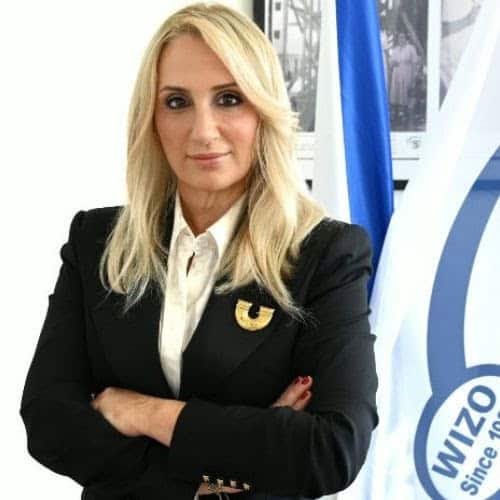
By: Anat Vidor, WIZO President
There sits one woman, Kala Walsh, not a small lunatic and the daughter of a professor at Boston University, sheltering under the label “American left-wing activist” – who calmly and politely sets out her doctrine. “Zionists” have turned the world into a battlefield, she intones, and immediately jumps to the remedy: Israeli diplomats should be killed, on U.S. soil and everywhere else. “Why aren’t there a hundred Elias Rodrígez yet?” she wonders, invoking as a “saint” the man who, earlier this year, shot and killed Jewish diplomats. The interview, like the murder it referenced, takes place in Washington, D.C. There, in a quiet, cultured studio, styled like a warm walk-in closet at home, a courteous interviewer listens to the twenty-two-year-old as a student to her rabbi, and solemnly absorbs the incendiary words.
No police burst into the studio from behind one of the closets; the broadcast does not abruptly cut off as if a cable had been severed; Walsh is not summoned to a round of appearances at the local police station. The entire sober discussion about the “importance” and “justice” of murdering Jews proceeds with the nonchalance of a legitimate worldview.
And it is not only America. In the Netherlands, police stormed the home of Tal Barkai, a Dutch Jew who has lived in Amsterdam for 45 years – following a false complaint by a neighbor alleging he possessed a weapon. Arabic speaking officers assaulted him so violently that his bones were broken. In London, the supposed homeland of civility and restraint, masked men wearing kaffiyehs stormed the lecture of Professor Michael Ben-Gad, an Israeli lecturer at a London university, and in front of students threatened to decapitate the economist, claiming that forty years earlier he had served in the IDF. One could continue a globe-spanning tour with similar and other stories, in varying degrees of violence and in different languages. What unites them is this: hate crimes against Jews are treated lightly, answered with lip-service of faux bellicosity and zero substantive action, and the number of arrests and punishments is comparable to those after the Kishinev pogrom of 1903 or the Hebron massacre of 1929, that is to say, a negligible minority whose consequence is merely the appearance of punishment rather than genuine prevention and deterrence.
It could be otherwise. For example, in Munich, police forces raided the home of former writer and politician Jürgen Todenhöfer, arrested him, and initiated proceedings after he compared the IDF to the Nazis. But that is an exceptional case, a mouse chased by a cat – which only reminds us that when there is the will, action is possible. Yet for every single incident that is acted upon, there are thousands in which the authorities sometimes including in Israel, receive antisemitism with a degree of understanding, conceding that it cannot be defeated by force.
The Jewish people must never consent to the normalization of a debate framed as “murdering Jews: for and against.” Our role as the persecuted of the world obliges us to remain strong, both militarily and morally, and not to despair even in dark days. Today we stand against furious jihadists, myriad executioners, so-called “freedom fighters” who mistakenly or not – fight against us, hypocritical supporters of terror wrapped in piety, and old-school antisemites who parade as “left activists.” Against all of them, we must confront reality: for the moment we are almost alone in this struggle. But also with the knowledge that, over the years, we will serve as a beacon for the nations, leading the human camp and pointing the way toward a better future. With eternity marching down the endless road to redemption – that is our story, yesterday and today.
There are good and decent people in Sweden, many of them supporters of Israel and opponents of terror. There are kind-hearted Swedes who see no issue with the fact that the most common name among Swedish children today is “Mohammed.” And I worry for them. Because cultured, pleasant nations like the Swedes tend not to fight back – until it’s already too late. “When they came for the Jews – I did nothing,” says the famous parable. “When they came for the dissidents – I did nothing. When they came for the LGBTQ people – I did nothing. When they came for the elderly, the disabled, and the Roma I did nothing. And when they came for me, there was no one left to fight beside me.”
These words are written as I prepare to leave for Stockholm, for a festive WIZO gathering. Alongside the excitement and anticipation of meeting my friends, this year there is also a sense of deep concern.
Because in a country where books are burned – people will soon be burned as well.
And in a state where a Jewish film festival cannot take place, who can say whether, in five or ten years, a WIZO conference will still be able to take place there at all.